
1. Natural Outbreaks
Throughout history, pandemics like the 1918 Spanish Flu and COVID‑19 have demonstrated how rapidly a novel virus can spread globally. Modern travel, dense populations, and delayed detection can turn a local outbreak into a worldwide catastrophe within weeks.
2. Engineered Bioweapons
Advances in synthetic biology make it possible to engineer pathogens with enhanced transmissibility, lethality, or resistance to existing treatments. A deliberate or accidental release of such a pathogen could overwhelm healthcare systems and cause societal collapse.
3. Global Preparedness
Stockpiling antiviral medications, rapid vaccine development platforms, and robust public health infrastructure are essential. Individuals should store N95 masks, gloves, and at least a 30‑day supply of food, water, and essential medicines.
A pandemic does not arrive with warning or ceremony. It often begins quietly somewhere in the natural world, where a virus circulating among animals undergoes a small but significant genetic change. A single mutation, a chance encounter, and suddenly a pathogen crosses the invisible boundary between species. This process, known as zoonotic spill over, has always been part of human history. As biological anthropologist James Holland Jones explains, such spill-overs are not new. What has changed is the world in which they occur. Today, a local outbreak can rapidly transform into a global crisis because human society itself has become the perfect vehicle for disease spread.
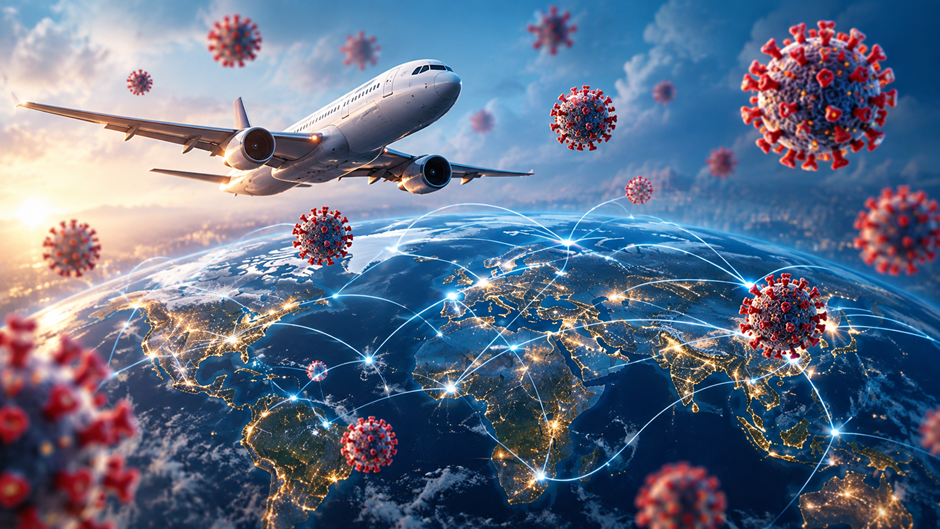
Modern life is defined by movement. People travel constantly for work, education, safety, or leisure, connecting distant parts of the world in a matter of hours. In this highly mobile environment, pathogens move as easily as people do. According to Erin Mordecai, one of the strongest predictors of how diseases spread is the network of global flight connections. Cities linked by frequent air travel effectively become neighbours in terms of disease transmission. A virus no longer needs years to travel across continents; it can do so in a single day, carried unknowingly by an infected traveller.
Global air travel and disease spread
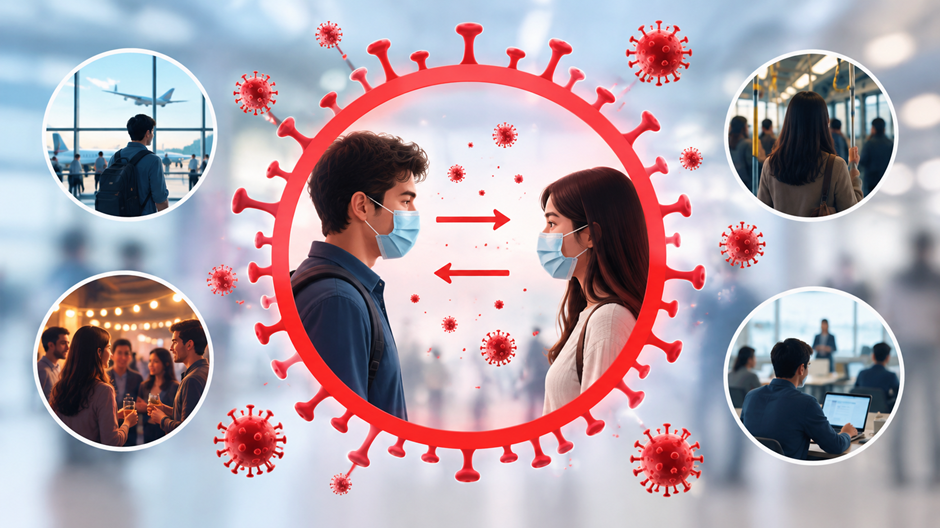
This reality becomes even more dangerous when dealing with diseases that spread silently. The global experience with COVID-19 in 2019 revealed how difficult it is to control a pathogen that can be transmitted by individuals who show no symptoms. People who feel healthy continue their daily routines, boarding planes, attending gatherings, and unknowingly spreading the virus. From a public health perspective, such diseases are particularly challenging, as traditional methods of detection and containment struggle to keep up.
Asymptomatic transmission of viruses
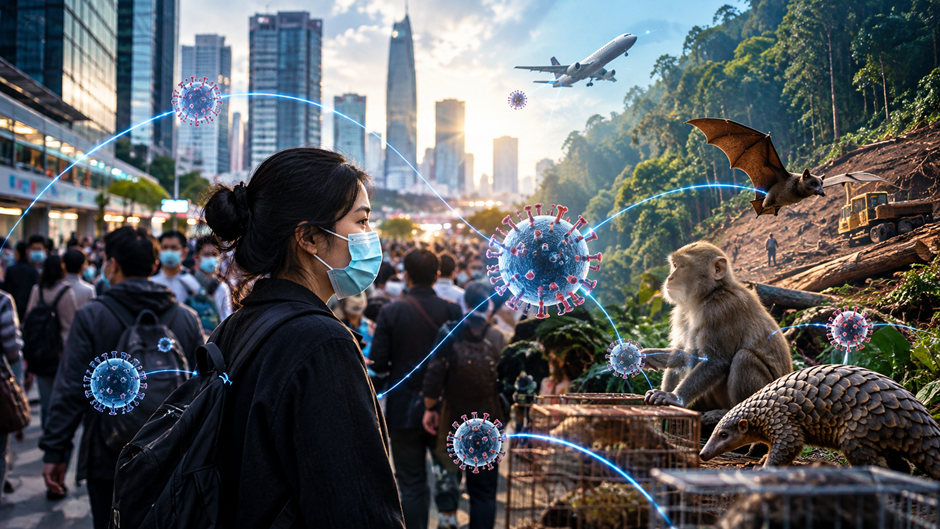
Yet global mobility is only part of the story. Human behaviour and environmental changes have also increased vulnerability to pandemics. Rapid urbanization has led to densely populated cities where people live and interact in proximity, creating ideal conditions for disease transmission. At the same time, activities such as deforestation and wildlife trade bring humans into closer contact with animal species that may carry unfamiliar pathogens. These disruptions to natural ecosystems increase the likelihood of zoonotic spill over, making the emergence of new diseases more frequent.
Throughout history, pandemics have repeatedly demonstrated their capacity to reshape societies. From ancient plagues to modern outbreaks, they have disrupted economies, altered cultural practices, and exposed deep inequalities. The COVID-19 pandemic served as a stark reminder that even with advanced medical knowledge, humanity remains vulnerable. Schools closed, businesses shut down, and entire economies slowed dramatically. Those already at a disadvantage often suffered the most, highlighting how pandemics amplify existing social and economic inequalities.
Did you know
- The Black Death (1335–1355) wiped out tens of millions, reshaping populations and leaving a deep, lasting mark on European history.
- The 1918 influenza pandemic spread across the globe, causing immense loss of life and proving deadlier than many major global conflicts.
- The 1918 influenza pandemic killed more people than World War I, underscoring the immense and often underestimated power of infectious diseases.
- Climate change is reshaping ecosystems, increasing human-animal contact and raising the risk of new zoonotic diseases emerging.
- High population density in cities allows diseases to spread faster, making outbreaks more intense and significantly harder to control.
- Large populations of domesticated animals act as reservoirs, increasing the likelihood of diseases jumping from animals to humans.
- Face masks play a vital role in reducing respiratory virus transmission, especially in crowded spaces and high-risk environments.
- Early detection systems are crucial for identifying outbreaks quickly and preventing them from escalating into full-scale global pandemics.
- Scientists depend on advanced computer models to simulate disease spread and guide timely, effective public health responses.
- The term “pandemic” comes from the Greek, meaning “all people,” reflecting its widespread and global impact across human populations.
- Vaccination campaigns successfully eradicated smallpox, marking the only time a human disease has been eliminated worldwide.
- In some regions, the Black Death reduced populations by nearly half, dramatically transforming social, economic, and cultural structures.
- Although HIV/AIDS has no cure, modern treatments enable people to live long, stable, and relatively healthy lives.
- COVID-19 vaccines were developed in less than a year, showcasing remarkable speed and progress in modern medical science.
- Antibiotics do not work against viruses, as they are specifically designed to treat bacterial infections, not viral diseases.
- The increasing availability of advanced biotechnology is raising concerns about bioterrorism, particularly among well-resourced and capable groups.
- Viruses that infect humans are mainly DNA or RNA types; RNA viruses like influenza, HIV, and SARS-CoV-2 mutate rapidly and adapt quickly.