
Massive eruptions (e.g., Yellowstone Caldera) could eject enormous amounts of ash and gases into the atmosphere. Ash clouds would block sunlight, triggering a "volcanic winter" and global cooling.
Agriculture could collapse worldwide, leading to famine and economic breakdown. Air travel, infrastructure, and supply chains would be severely disrupted. Past events like the Toba supereruption show how extreme eruptions can impact global populations.
While human extinction is considered unlikely, a supervolcano eruption is one of the most powerful natural events on Earth and could cause the collapse of modern civilization.
Beneath the calm surface of our planet lies a force so immense that, when released, it can reshape continents and alter the global climate. These rare but powerful systems, known as super volcanoes, are among the most extraordinary geological phenomena on Earth. Unlike ordinary volcanoes that erupt lava and ash over relatively limited areas, super volcanoes can unleash eruptions thousands of times larger events so vast that their effects can be felt worldwide.
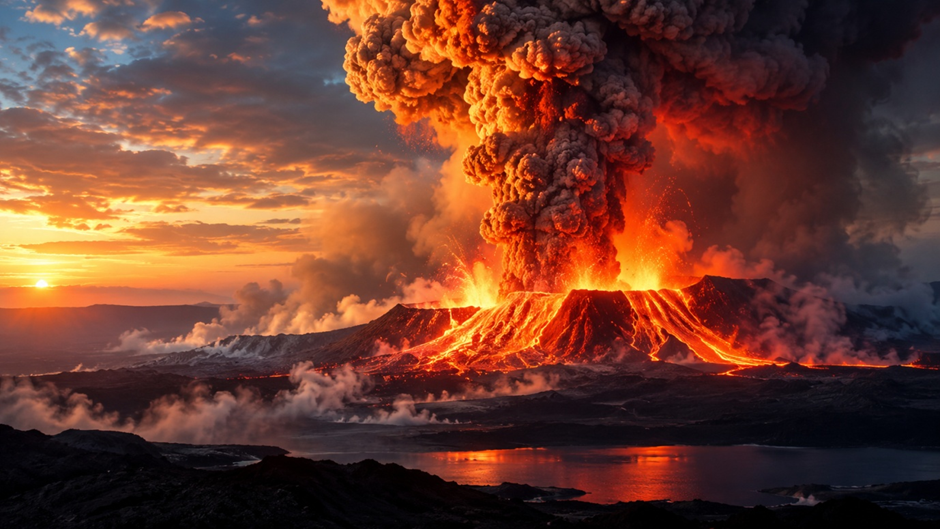
Supervolcano eruption
Super volcano is a term for a volcanic system that produces an eruption with an ejected volume of at least 1,000 km3 (240 mi3), equivalent in scale to a magnitude 8 eruption on the Volcano Explosivity Index (VEI). The term has no scientific definition, but it has been commonly used to describe these large systems and their periodic "super eruptions".
Magma accumulation
A super volcano begins as magma amasses within a planet's crust over geologic timescales. Super volcanoes can be fed by a mantle plume or by tectonics, when heat slowly rises from the interior of a planet. Eventually, a large volume of magma forms inside underground chambers tens of kilometres wide, and gases dissolved in the magma come out of solution and build up pressure.
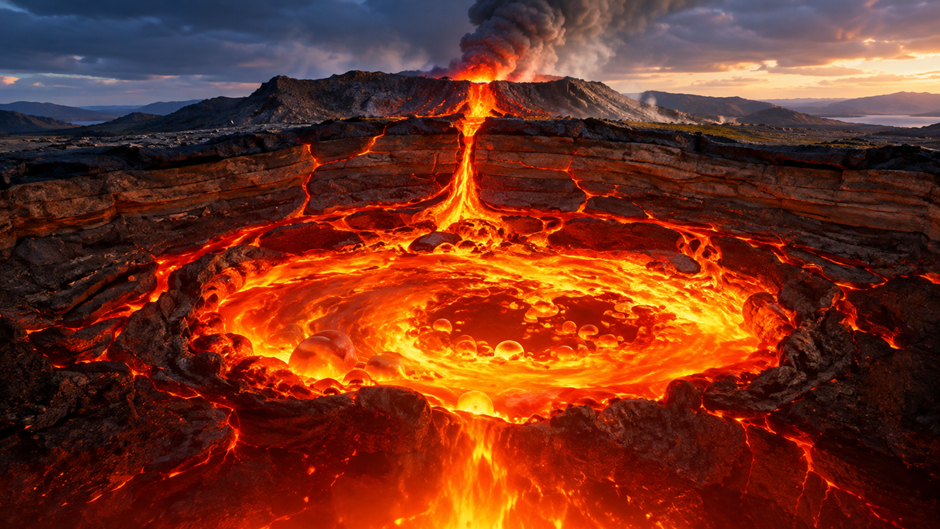
Unlike small volcanoes, super volcanoes take a very long time to form because the rock above the magma chamber acts as a lid, slowly weakening the crust and producing fractures that eventually weaken it enough to cause failure and a catastrophic volcanic eruption.
During a super eruption, the quantity of magma is huge, and as a chamber empties, the ground surface above the emptied magma chamber sinks, forming a depression called a caldera. Super eruptive calderas are typically greater than 50 km (31 mi) in diameter. For example, Lake Toba in Indonesia formed during a super eruption 74,000 years ago and this eruption may have affected early humans. Super volcanic eruptions can eject enough ash to change the skies over continents, darkening them and affecting life beyond the immediate area.
Nonetheless, super eruptions are extremely rare events, the most recent occurred about 26,500 years ago at New Zealand's Taupō volcano. For comparison, the 1991 eruption of Mount Pinatubo was a VEI 6 event around 100 times smaller than a super eruption.
Caldera formation
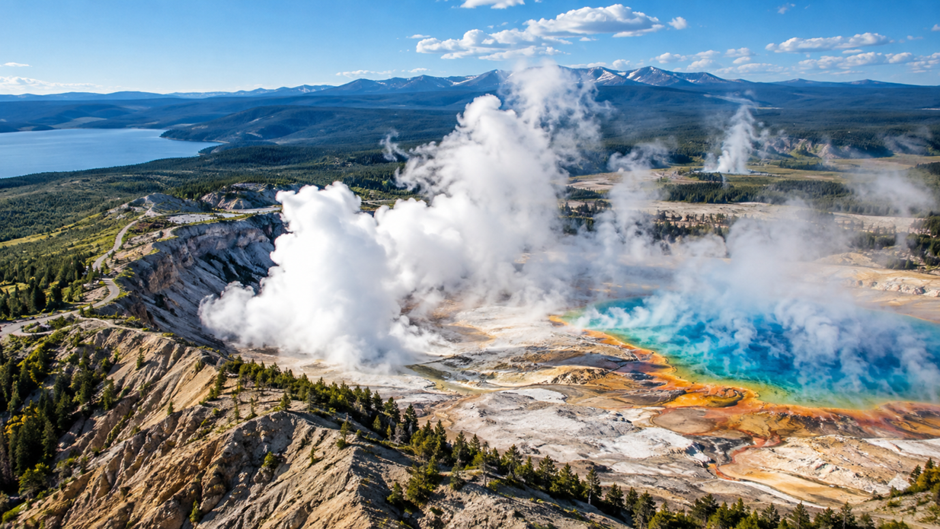
Several volcanic systems show potential for such eruptions, including Yellowstone, Long Valley, Valles Caldera, Toba, and Taupō. Yellowstone, often labelled a super volcano, has produced three major eruptions over the past 2.1 million years. However, most of its activity has been much smaller, showing that super volcanoes do not always produce super eruptions.
Yellowstone
In fact, many remain relatively quiet, producing smaller eruptions or geothermal activity. The Campi Flegrei region in Italy, for example, is known more for gas vents than major eruptions. This variability makes classification difficult.
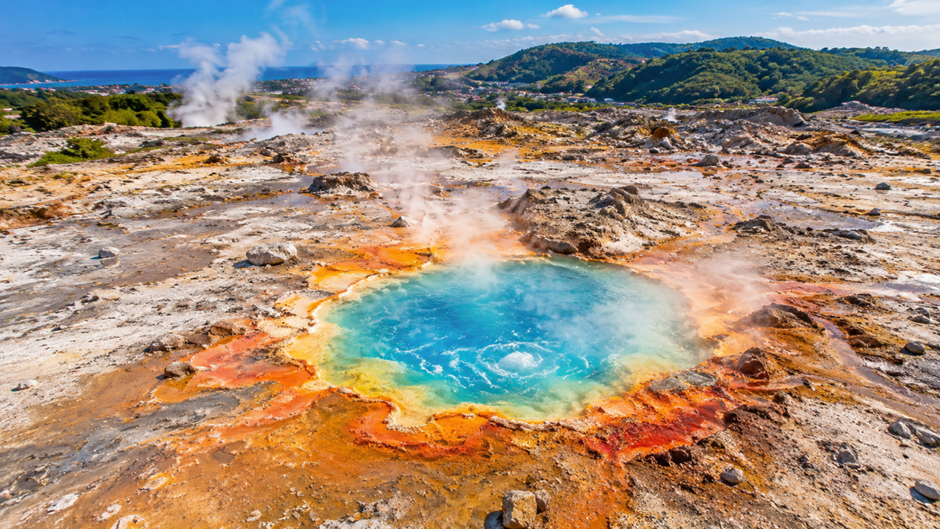
A common question is whether any super volcano is "overdue." Yellowstone is often discussed, but scientists warn that volcanoes do not follow predictable schedules. Current research suggests its magma is mostly solid, meaning a major eruption is unlikely. Future activity would more likely involve small eruptions or hydrothermal events.
Although the chances of a super eruption in our lifetime are extremely low, scientists continue to monitor these systems. Techniques such as seismographs, satellite observations, and gas analysis help detect warning signs like ground movement and increased seismic activity. These monitoring systems are crucial for early alerts and risk reduction.
The global impact of a super eruption, however, would be significant. Gases like sulphur dioxide can form aerosols that reflect sunlight and cool the Earth, potentially disrupting climate, agriculture, and ecosystems worldwide. Entire regions could face temporary cooling and reduced crop yields.
Beyond climate effects, the social and economic consequences would also be severe. Ash clouds could disrupt transportation networks, air travel could be grounded for extended periods, and food supply chains could face global stress. Even regions far from the eruption site would feel indirect impacts through economic slowdown and resource shortages.
In the end, super volcanoes remind us of the immense forces shaping our planet. While rare, their potential impact is profound. Understanding them not only deepens our knowledge of Earth but also helps humanity remain aware and prepared for events that could one day reshape the world.
At the same time, they highlight the dynamic and ever-changing nature of Earth itself. Beneath seemingly stable ground, powerful processes are constantly at work, slowly reshaping the planet over geological time. Studying these systems also improves our ability to interpret other planetary bodies, as similar volcanic features have been observed on Mars and Venus.
Did You Know
- Earth has over 1,000 active volcanoes scattered across its surface, but only a rare few have unleashed eruptions so massive they are classified as super volcanoes.
- These super eruptions can create enormous calderas collapsed volcanic craters that may stretch more than 50 kilometres wide.
- A magnitude-8 eruption is almost beyond imagination, and no human has ever witnessed one. The most recent example was the Taupō eruption in New Zealand, around 26,500 years ago.
- In comparison, the 1991 eruption of Mount Pinatubo in the Philippines was one of the most powerful in modern history. Yet, it only reached VEI 6 about 100 times smaller than a true super eruption.
- Among today’s active volcanoes, Hawaii’s Mauna Loa stands as the largest on Earth. Rising over 4 km above sea level and extending deep beneath the ocean floor, its total height from base to summit is about 17 km.
- In terms of global distribution, the United States ranks third in the world for historically active volcanoes, after Indonesia and Japan. Many of these are located in Alaska, the Aleutians, Hawaii, and the Cascade Range.
- The largest volcanic eruption of the 20th century occurred in 1912 at Novarupta in Alaska. It released around 15 cubic kilometres of magma and created what scientists later called the “Valley of Ten Thousand Smokes.”
- The term “super volcano” itself is not an official scientific category, but it is widely used to describe volcanic systems capable of producing extremely large eruptions.
- A single super eruption can release more material than thousands of normal volcanic eruptions combined, making it one of the most extreme natural events on Earth.
- Such eruptions can even trigger a “volcanic winter,” temporarily lowering global temperatures by several degrees due to ash and gases blocking sunlight.
- Super volcano eruptions are classified at Level 8 on the Volcanic Explosively Index (VEI), the highest possible category.
- Interestingly, some super volcanic systems can show signs of unrest for thousands of years without actually erupting.
- The Taupō volcano in New Zealand is one such system, known for producing multiple massive eruptions throughout its geological history.
- During eruptions, gases like sulphur dioxide can enter the atmosphere and react to form acid rain, affecting ecosystems far from the eruption site.
- Even when a full super eruption does not occur, smaller eruptions from these systems can still cause significant regional disruption and environmental impact.