
A brilliant flash crosses the sky. People walk towards windows to see what happened. The rock has already broken apart high above them, so it seems that the danger must be over. Then a pressure wave reaches the town and glass flies into rooms.
That is why an asteroid airburst deserves attention. A space rock can release destructive energy in the atmosphere without leaving a large impact crater. The damage comes from how rapidly its energy is transferred to the air, and from what that disturbance encounters below. Reaching the ground as one enormous boulder is not a requirement for disaster.
This is an explanation of a real hazard, not a warning that an airburst is expected over Britain. Understanding the mechanism helps us take detection seriously, recognise misleading footage and avoid the dangerous assumption that a spectacular light has finished doing harm simply because it has disappeared.
What an asteroid airburst actually means
A small body entering the atmosphere is travelling extremely fast. As it encounters denser air, intense stresses and heating can cause it to break up. The fragments expose more material to the atmosphere, allowing energy to be deposited over a relatively short part of the flight.
The result can include an intense flash and a powerful pressure wave. It is not necessary to imagine a conventional bomb inside the rock. Its motion supplies the energy. Its structure, speed, entry angle and the air around it influence where and how that energy is released.
Some fragments may survive and reach the surface as meteorites. Others are destroyed or dispersed. The terms describe different parts of the event: an object in space, the visible atmospheric phenomenon and material that survives to the ground. NASA's meteor and meteorite guide explains these distinctions.
Chelyabinsk showed why the flash is not the finish
On 15 February 2013, an incoming object broke up over the Chelyabinsk region of Russia. The event became an important case for studying atmospheric entry and the damage a relatively small space object can cause. It also left a memorable public lesson: people can see an event before the associated pressure disturbance reaches them.
NASA's account of the international investigation describes evidence collected from the event. It is a historical observation, not a template that predicts the next object's height, path or damage pattern.
For a household, the practical implication is straightforward. A bright sky event is not an invitation to stand against glass and film. Moving closer to a window can turn curiosity into exposure. A recording can be replaced; an injured eye cannot be treated as a trivial cost of obtaining a better view.
Why a crater is the wrong safety test
People often picture asteroid danger as a hole in the ground surrounded by destruction. That picture leaves out the atmosphere. Air can carry a damaging disturbance across a wide area even when most of the original material does not reach the surface intact.
The absence of a crater therefore cannot establish that nothing serious happened. Investigators examine other evidence: the recorded light, pressure signals, fragment distribution, damage and observations from different locations. No single social media photograph supplies all of that information.
Equally, a damaged roof or broken branch does not prove that an asteroid caused it. Strong winds, structural faults and other events can produce superficially similar scenes. The lesson is to keep the mechanism open to evidence, rather than deciding that every unexplained bang must be an airburst.
Tunguska is a warning, not a ready-made forecast
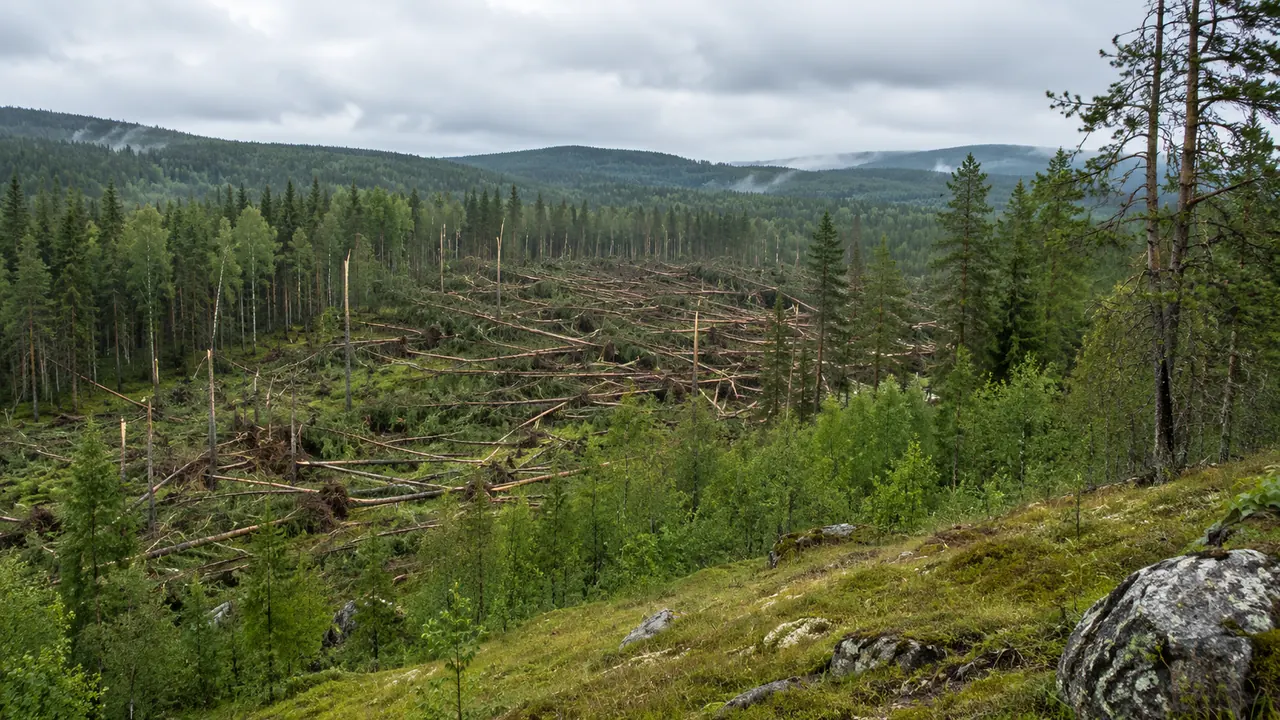
The 1908 Tunguska event in Siberia flattened a large forested area. It remains a central example in research on energetic atmospheric entry. NASA's discussion of later Tunguska research also explains why researchers revise estimates as their understanding improves.
It is reasonable to ask what comparable energy release could mean over an inhabited area. It is not reasonable to copy the forest footprint onto a city map and call the resulting boundary a precise prediction. Buildings, terrain, entry characteristics and the event itself would matter.
Historical examples are most useful when they improve the questions we ask. How high was energy deposited? What kind of object entered? Which observations constrain the model? Those questions produce a more serious discussion than a dramatic image with an unexplained circle drawn around a capital city.
The factors that decide whether damage reaches people
Size matters, but diameter alone does not describe an incoming object. Two bodies of similar apparent size may differ in density and strength. Their trajectories may also expose them to different atmospheric conditions before breaking up.
A high energy release can affect the ground differently from a lower one. The angle of entry changes the path through the atmosphere. Fragmentation changes how the remaining energy is distributed. Scientists therefore work with uncertainties rather than treating an early estimate as a complete engineering drawing.
Then there is exposure. An event above a sparsely inhabited landscape and one affecting a busy urban area have very different consequences for people. Hospitals, schools, transport interchanges and large glazed buildings create their own vulnerabilities. A hazard becomes a disaster through the meeting of a physical event and the society beneath it.

Why windows can turn an event into a medical emergency
Glass is a familiar material, so its danger is easy to underestimate. A room may look sheltered while its occupants remain directly beside a vulnerable surface. A pressure disturbance can transform that surface into many sharp moving pieces.
The sensible immediate priority after an unexplained intense flash or blast is personal protection, not identification. Move away from windows and exposed glass if you can do so safely. Do not approach a damaged frontage to inspect it, and do not gather beneath broken glazing.
After damage, separate the question of treating injuries from the question of explaining the sky. Serious bleeding, breathing difficulty, eye injury or other urgent medical problems need emergency help. Avoid rubbing an injured eye or attempting to remove embedded material. Follow emergency call-handler instructions rather than advice from a sensational video.
An airburst is not a nuclear detonation
A bright flash and a loud blast can lead to frightening comparisons. Similar visible features do not establish the same cause. An asteroid airburst does not become a nuclear explosion because a headline compares its energy with an explosive yield.
That distinction matters when people begin sharing claims about fallout, mysterious radiation or an attack. Specific hazards require specific evidence. A speculative label can direct a family towards an inappropriate response while the actual immediate danger, such as broken glass or a damaged building, receives less attention.
Do not build a diagnosis from colour alone. Camera settings, distance, clouds and image processing affect what a recording looks like. Where authorities are investigating an event, use their confirmed findings and applicable protective advice. An uncertain cause is a reason to keep checking, not permission to invent one.
Can astronomers always provide advance warning?
No observing system can promise that every incoming object will be discovered early enough for a detailed public response. Smaller bodies can be difficult to detect, and viewing geometry can make an approach harder to observe. This is one reason planetary defence includes both research and improved surveying.
The NEO Surveyor mission is designed to improve the discovery and characterisation of near-Earth objects using infrared observations. Its purpose illustrates why better instruments matter; it is not a guarantee that every local atmospheric event will come with a useful countdown.
Our article on asteroid detection blind spots explains the difference between discovering an object and understanding its orbit. Short warning also changes the available response. A long-planned deflection mission and immediate local protection are different tasks, operating on very different timescales.

Read an airburst claim without spreading a false alarm
Before forwarding a dramatic clip, establish when and where it was recorded. An authentic historical video can still mislead if someone presents it as an event happening today. A computer-generated reconstruction can be educational while becoming deceptive when its explanation is removed.
Look for the original organisation's publication rather than a screenshot of a logo. Check whether the report describes an observed event, a model, a hypothetical exercise or an unconfirmed account. Those categories should not be silently exchanged.
| Claim you encounter | Question worth asking | Why it matters |
|---|---|---|
| A city will be destroyed tonight | Which named authority issued this assessment? | A precise deadline needs identifiable evidence |
| No crater means there was no hazard | Has atmospheric energy release been considered? | Surface impact is only one damage mechanism |
| This video proves the object was huge | Is there a reliable scale and original recording? | Brightness and perspective can mislead |
| The alert vanished, so facts were hidden | Was the assessment updated or the post corrected? | Changed information needs context |
What a credible public message should tell you
A useful warning connects an assessment to an action. It should identify the affected location, the source, the time of the update and what people should do next. A spectacular prediction with no practical boundary leaves households frightened but poorly informed.
If an event has already caused damage, messages may focus on building access, dangerous roads, medical support and utility repairs rather than the final scientific explanation. That is not necessarily a contradiction. Different agencies can be responsible for different parts of the incident.
Keep a distinction between a scientific update and an evacuation instruction. Do not leave a safe location solely because an unrelated video uses the word asteroid. If local emergency services direct you away from a damaged area, follow the applicable instruction even while investigators are still determining exactly what happened.

The disruption can continue after the noise stops
A family might escape injury yet find that its usual route to work is closed, a school cannot reopen or a nearby shop has damaged glazing. Businesses may need repairs before customers can return. A short physical event can therefore create a longer social and financial interruption.
People who depend on regular care, accessible transport or powered medical equipment may feel those interruptions more sharply. That does not mean every airburst would cause all these failures. It means a local response should examine service dependencies, rather than count broken windows and declare the community fully recovered.
Recovery also creates opportunities for misinformation and fraud. Be careful with unsolicited repair offers, requests for deposits and appeals claiming to represent affected families. Verify the organisation independently. A real incident does not make every person using its name trustworthy.
A realistic family discussion is more useful than a disaster film
Imagine a parent hears a bang while a child is in another room. Their first task is to check immediate safety and keep the child away from damaged glass. Searching for the most frightening explanation would not help with that task.
Now imagine a different situation: the family sees a clip from another country and there is no local incident. Their useful task is to check the source and avoid telling a child that the same event is certain to happen outside their home. These situations require different decisions even though both involve an airburst story.
Simple language helps. Explain that the sky contains small objects, that most visible meteors do not create disasters, and that scientists study the uncommon dangerous cases carefully. Children deserve a truthful account that leaves room for questions, rather than either a false promise or an invented catastrophe.
Where this threat fits into the wider asteroid picture
An airburst is one possible outcome of atmospheric entry. It should not be used to dismiss hazards associated with larger impacts, nor should larger-impact research be applied automatically to every bright meteor. Physical scale and conditions change the problem.
For example, the mechanisms discussed in an ocean impact and coastal risk are not interchangeable with a pressure wave from an airburst over land. Likewise, longer-term food-system disruption requires a different chain of effects and assumptions.
Understanding those distinctions makes the threat more intelligible. It prevents one frightening label from swallowing all the science. A household can take the possibility of sudden local damage seriously while still asking whether a particular global claim has the evidence to support it.
Your next step
Choose one recent-looking asteroid or meteor story and trace it back to its original source. Check its date, event type and level of certainty. Practise explaining the difference between a bright meteor, a damaging airburst and a surface impact without treating them as identical.
Then look at an ordinary room in your home. Consider how you would move a child or someone with limited mobility away from windows after an unexpected blast, without crossing broken glass. This is a useful exercise in immediate protection, not a prediction that an asteroid event is approaching.
The threat deserves attention because absence of a crater does not guarantee absence of harm. The response deserves discipline because a false alarm can cause its own injuries and confusion. Better understanding supports both scientific investment and safer individual decisions.
Frequently asked questions
Can an asteroid cause serious damage without hitting the ground intact?
Yes. Rapid energy release during atmospheric breakup can produce a damaging pressure wave. The consequences depend on the object, entry conditions, height of energy release and the people and structures exposed below.
Does every bright meteor mean that an airburst disaster is coming?
No. Brightness alone does not establish size, damage potential or a dangerous trajectory. Most meteor observations do not lead to a damaging event. A particular claim needs reliable observations and an appropriate scientific assessment.
Why should people avoid windows after a sudden intense flash?
Light can be seen before a related pressure disturbance arrives. Standing beside glazing to watch or film can increase exposure if it breaks. Move away from glass where safe and follow any applicable emergency instructions.
Would an asteroid airburst automatically create radioactive fallout?
No. An asteroid airburst is not a nuclear detonation. Do not infer radioactive fallout from a bright flash, an energy comparison or an unverified video. Any specific contamination warning needs evidence and relevant official advice.
Is there a current warning of an airburst over the UK in this article?
No. This article explains a hazard using historical events and planetary-defence research. It does not identify an incoming object or issue a public warning. Check current official information for any actual incident affecting your location.