
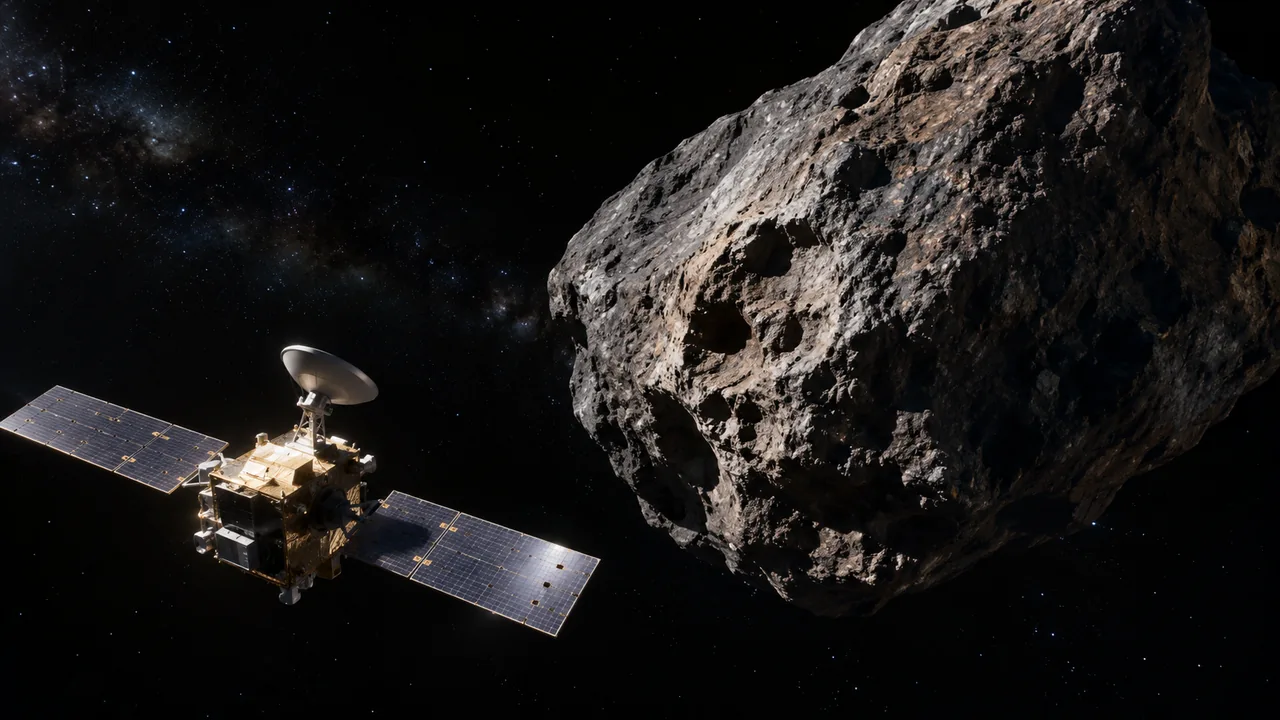
A spacecraft striking an asteroid sounds like the final scene of a disaster film. In reality, asteroid deflection is less about a spectacular explosion and more about changing a moving object's future position by the right amount, early enough. A successful mission could protect people by turning a predicted collision into a miss. A late discovery, uncertain target or unsuitable mission could leave far fewer choices.
NASA's DART demonstration established that a deliberately targeted spacecraft impact can change an asteroid moonlet's motion. It did not intercept a body heading towards a city, and it did not prove that every future threat can be stopped. That difference is central to understanding both the achievement and the remaining danger.
For families, the issue is trust in a capability that must work long before the sky looks threatening. Planetary defence needs observations, engineering, decisions and time. None can be replaced by confidence that somebody will launch a last-minute rescue.
What DART actually demonstrated
On 26 September 2022, NASA's Double Asteroid Redirection Test struck Dimorphos, the smaller member of the Didymos asteroid system. The target was selected for a controlled demonstration and posed no impact threat to Earth. Scientists measured a change in its orbital motion around its larger companion.
The NASA account of the DART results explains why this was an important test of the kinetic-impact method. Kinetic means motion: the spacecraft delivered momentum by colliding with the target. Observations then established what happened rather than simply assuming that a collision counted as success.
A real protective mission would face a different decision problem. Its target, time available and required change would come from the actual encounter. Demonstrating a physical method is a major step, but it is not the same as maintaining a ready solution for every possible incoming object.
Deflection is different from blowing an asteroid apart
The aim of a kinetic impactor is to change motion usefully. It need not destroy the entire asteroid. The danger depends on where material will go afterwards, so an impressive explosion would not by itself establish that Earth had been protected.
Breaking a body into pieces can create a difficult tracking and outcome problem if the fragments remain on hazardous paths. The correct result must be evaluated in terms of the future encounter, not the visual size of an impact cloud. A dramatic image can make the wrong thing look like the measure of success.
Think of the task as changing an appointment in space. Earth and the asteroid must no longer arrive at the same dangerous place together. That comparison is only an explanation of the objective; actual mission planning requires orbital calculations rather than a straight-line sketch or a guess about which direction looks safest.
Why a small change can matter years later
A modest alteration can accumulate into a useful difference in future position when sufficient time remains. With much less time, a comparable change may be inadequate. The time before the encounter therefore influences the mission's practical requirements.
The NASA technical description of DART discusses the need for an appropriately sized spacecraft and adequate warning, typically years to decades for the method considered. That is why early detection belongs inside the defence system rather than being treated as a separate scientific luxury.
The article on asteroid detection blind spots explains how observing conditions can reduce that warning. A spacecraft that could have been useful several years earlier may no longer provide the necessary result when an object is discovered close to its encounter. Hardware cannot recover time that has already passed.
The target's structure changes the outcome
Asteroids are not identical solid balls. Their mass, shape, surface and internal structure affect how an impact transfers momentum and how material leaves the body. A mission must work with the target that exists, not the convenient object used in a simple animation.
Material thrown out by the impact can contribute to the target's change in motion. Its behaviour is therefore scientifically important, not just background dust in a photograph. Uncertainty about the target becomes uncertainty that engineers and observers need to reduce.
This does not make every unknown property a reason to abandon the method. It explains why characterisation, modelling and follow-up are essential. A statement that an impactor has a particular mass is incomplete without considering the body it will strike and the change the protective mission must achieve.
Hera turns one demonstration into better knowledge
ESA's Hera mission investigates the aftermath of the DART impact to improve understanding of the target and the deflection process. The ESA mission questions and answers explain its role within the international Asteroid Impact and Deflection Assessment collaboration.
In a November 2026 report on Hera's observations, ESA described the large crater and physical changes associated with DART's strike. The scientific value is in connecting the observed surface and structure with the measured outcome, rather than treating the photograph as another collision warning.
This follow-up matters because future mission designers need more than the statement that DART worked. They need a better basis for estimating what a different spacecraft would do to a different target. Investigation after the demonstration is part of developing the method's reliability.
Finding the asteroid remains an essential first condition
A mission cannot be designed around an object whose relevant path is still unknown. Observations establish the encounter problem and help distinguish a concerning possibility from a confirmed need for protective action. Follow-up is therefore connected directly to responsible decisions about intervention.
The CNEOS explanation of changing risk estimates shows why early assessments can change as more observations refine an orbit. A revised estimate is not automatically proof that the system failed or that an impact has become certain.
For an ordinary reader, keep three announcements separate: an object has been discovered, a particular encounter needs assessment, and a protective mission has been proposed. Each is meaningful, but none should be silently substituted for the others. A discovery headline does not mean a city is already being evacuated.
Launching the mission is another part of the challenge
A spacecraft needs a suitable design, launch opportunity, navigation and enough operating time to reach the target. Its route must make a useful encounter possible rather than merely place hardware somewhere near the asteroid. Engineering readiness and the actual trajectory both matter.
A mission that works in a study may still require construction, testing and authorisation. A launcher being available does not mean every other component can be assembled instantly. Public descriptions should distinguish a demonstrated technology, an approved mission and an idea that remains under investigation.
This is a practical reason to value sustained work before a threat is confirmed. Waiting until the situation becomes urgent can compress several demanding stages into the least forgiving period. Preparation at institutional level is not a guarantee of success, but its absence can remove options that should have remained available.

Hitting a moving target requires more than aiming from Earth
The spacecraft and asteroid both move through space while communication and navigation information have limits. A useful collision needs the right approach and impact conditions. Simply arriving in the general area would not establish that the intended deflection had been delivered.
DART's autonomous terminal navigation was part of what the demonstration tested. That achievement should not be confused with a promise that any system described as AI can manage any target. The performance belongs to a particular engineered mission and its actual evidence.
The wider lesson is that reliability comes from a chain of capabilities. If target knowledge, navigation or spacecraft health fails, a strong performance elsewhere may not compensate. Ask which parts of the chain have been tested and which assumptions a proposed new mission still relies on.
Verification matters after the impact
A successful collision must be followed by observations that assess its consequences. Mission teams need to know how the target's motion changed and whether the resulting path meets the protective objective. An impact flash or lost spacecraft signal is not enough to answer that question.
Where the measured result differs from the plan, further decisions may be required. The time remaining and the available capabilities would shape those choices. This is another reason why earlier action can be valuable: it may preserve time to observe and respond to an imperfect outcome.
Do not interpret the first dramatic image as an all-clear. Reliable public communication should distinguish confirmation of contact, initial measurements and an assessed reduction in the particular threat. The same careful sequence helps people understand progress without promising a result before it has been established.

A deflection decision crosses national borders
A genuine impact threat would involve scientific organisations, governments and international coordination. The consequences and responsibilities would not be confined to the country supplying a spacecraft. A credible assessment must be communicated so that appropriate authorities can consider protective action.
The primary account of IAWN and SMPAG explains the roles of the International Asteroid Warning Network and the Space Mission Planning Advisory Group. Observation and assessment, possible space missions and public protection are connected but distinct responsibilities.
This is not a household engineering project or a decision made by a popular social-media account. Readers can reasonably ask who has issued an assessment, which organisations are involved and what has actually been authorised. A proposal being discussed internationally is different from a launched mission with a confirmed outcome.
Protecting a city may also require action on the ground
Even where a space intervention is being considered, authorities may need plans for an event that remains uncertain or cannot be prevented. The scale and location would determine the appropriate measures. Space capability should not be used as a reason to neglect credible local instructions.
Conversely, a planning exercise is not an instruction to leave a city. Check the original source and current status before changing a journey or forwarding a claim. A fictional impact corridor can look persuasive when the exercise label is cropped from the slide.
The article on asteroid airbursts explains why the hazard on the ground depends on the actual entry and breakup conditions. Protecting people requires an assessment of that event, rather than assuming that every object produces the same damage pattern or that one headline tells every household what to do.
Five claims that need a closer look
| Claim | Missing question |
|---|---|
| We have already saved a city with DART | Was the demonstration target actually threatening Earth? |
| Any asteroid can be stopped | Under which target, warning-time and mission conditions? |
| The spacecraft hit, so Earth is safe | What do follow-up observations establish? |
| A larger explosion must work better | Where would the remaining material go? |
| A mission has been proposed | Is it designed, authorised, launched or only studied? |
These questions do not diminish the achievement. They connect it to the conditions that make the achievement useful. A clear explanation can celebrate a major advance while retaining an honest account of what remains uncertain.
They also protect against a familiar form of misinformation: taking a real scientific success and extending it beyond the evidence. Public confidence should rest on demonstrated performance and careful assessment, rather than the expectation that a complicated emergency always ends like a film.

What this means for a family following the news
Find the responsible scientific update and any relevant instruction from public authorities. Separate the object's assessment from the status of a proposed mission. Do not buy specialist supplies or change a major plan solely because an unverified account claims a deflection attempt has failed.
A household may have ordinary needs during a genuine disruption, including communication, care and access to services. Those needs should be addressed through credible local information rather than a copied orbital graphic. A distant technical discussion may not imply any immediate change where you live.
For children, explain the distinction between a test, a possibility and a current warning. They can understand that people are developing useful methods without being told either that the sky is perfectly safe or that a secret disaster has begun. Calm accurate explanations preserve trust when the next headline appears.
Your next step
When reading a planetary-defence story, identify the target, warning interval, mission stage and evidence of the outcome. Keep the original date with any shared information. Ask what remains to be measured before accepting either an alarming prediction or a sweeping promise of protection.
A spacecraft impact could form part of a mission that saves people from destruction. DART has made that possibility more concrete. The serious responsibility now is to turn a demonstrated technique into better understanding and realistic readiness, while preserving the time needed to use it. The dangerous mistake would be to treat a successful test as permission to stop looking.
Frequently asked questions
Did DART stop an asteroid that was about to hit Earth?
No. Dimorphos and Didymos did not threaten Earth. DART was a deliberately designed demonstration that changed the smaller body's orbital motion. It established an important capability without being an emergency interception of an incoming asteroid.
Why does an asteroid-deflection mission need early warning?
Time affects how much a small orbital change can alter a later encounter and whether a mission can be designed, launched and verified. A short interval can sharply restrict options. No single warning-time figure applies to every target and method.
Would destroying the asteroid always be safer than nudging it?
No. The relevant question is where the material will go afterwards. Fragmentation does not establish a safe outcome if hazardous pieces remain on threatening paths. A mission must be assessed against the actual encounter and its consequences.
What does Hera add after DART's successful impact?
Hera investigates the target and aftermath to improve understanding of the deflection process. Measurements of the body's properties and physical changes help connect the demonstrated outcome with models used for possible future missions.
Should an ordinary reader treat a mission announcement as an all-clear?
No. A proposal, launch, collision and verified protective outcome are different stages. Follow the responsible scientific assessment and any relevant public instruction. Do not infer a local warning or complete safety from one dramatic image.