
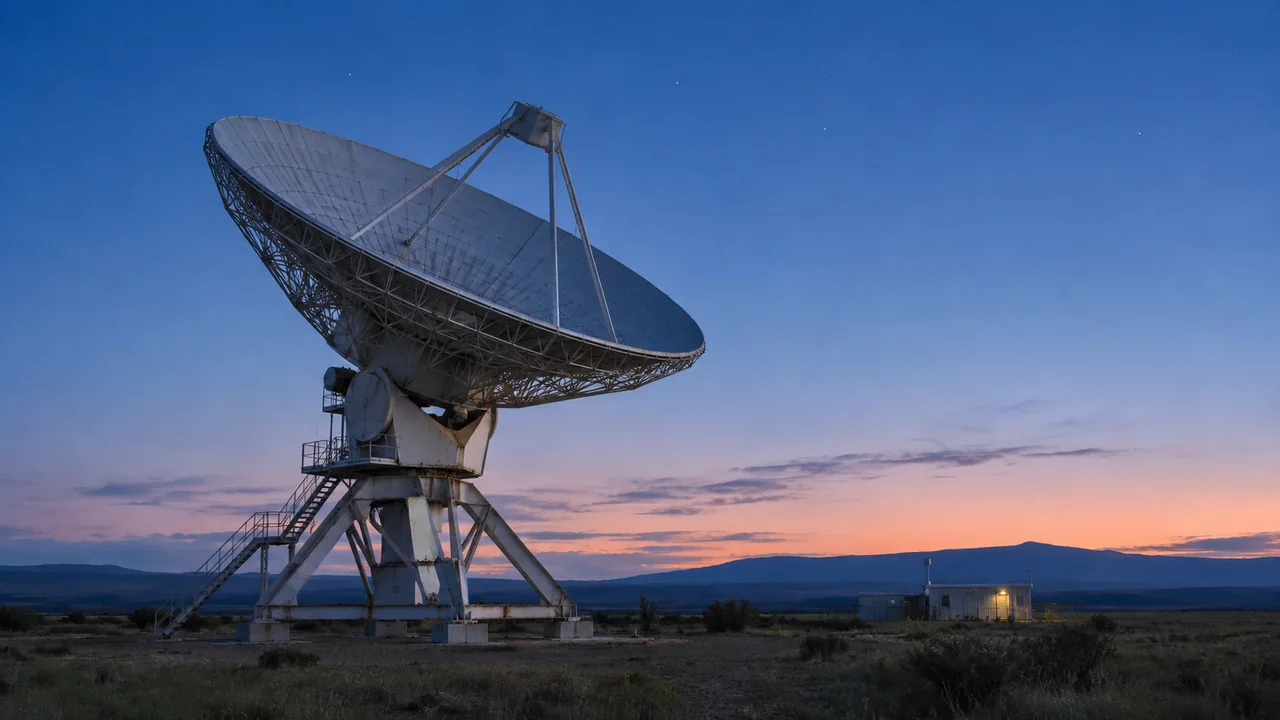
Sending a message can feel like the beginning of a conversation. Across interstellar distances, it could also be a decision whose consequences outlast the people who made it. Broadcasting Earth's location raises a difficult question: who should decide whether humanity deliberately attracts the attention of a civilisation whose intentions we cannot assess?
There is no confirmed hostile listener behind this question. We do not know that another technological civilisation is close enough, listening at the right time or capable of detecting a particular transmission. The concern is about decision-making under deep uncertainty, rather than an announcement that Earth has been targeted.
That makes the subject worth understanding properly. Listening for a signal, accidentally emitting energy and deliberately directing a powerful message are not identical acts. Neither silence nor transmission can be declared completely safe simply by choosing a dramatic story about what might be out there.
Listening and transmitting are different decisions
SETI, the search for extraterrestrial intelligence, includes attempts to identify evidence of technology beyond Earth. A listening experiment seeks information. Deliberate interstellar messaging, often called METI or active SETI, attempts to send information towards a possible recipient.
Those purposes can overlap scientifically, but they create different questions about consequences. Receiving a measurement does not in itself require sending a reply. A detection can be investigated while discussion continues about whether anyone should transmit.
The Berkeley-hosted statement on active SETI argues for broad international discussion before further deliberate high-powered messaging. It is an explicitly stated position in a debate, not evidence of an existing alien threat or a binding global rule.

Earth is not invisible, but that does not settle the issue
People sometimes dismiss the discussion by saying that Earth has already been broadcasting for years. Others imagine that stopping one transmission would make the planet entirely hidden. Both statements oversimplify detectability.
Different emissions have different strengths, directions and durations. A hypothetical receiver's distance, sensitivity and observing choices would also matter. The existence of a signal somewhere in space does not establish that a particular civilisation could identify it, interpret it or trace it in the way a story assumes.
There are also possible clues unrelated to intentional messages, such as observations of a planet itself. Whether such clues could be measured depends on circumstances. The sensible conclusion is neither guaranteed invisibility nor guaranteed discovery. The question is how a particular action might change an already uncertain situation.
A transmission is not an instant conversation
Radio and light signals travel at a finite speed. Interstellar communication therefore introduces delays that differ fundamentally from an online chat. A distant recipient could receive a message long after the transmitter's original political and social circumstances had changed.
A reply would require its own journey, assuming that anyone chose to respond and that the reply could be recognised. Not receiving a response would not establish hostility, absence or deliberate silence. The message might not have been detected at all.
This timescale changes the ethical discussion. The people who benefit from a transmission's publicity may not be the people who live with every possible consequence. A decision can be technically local and socially much wider, particularly when it is presented as speaking on behalf of humanity.
What does broadcasting a location actually reveal?
A detectable signal may convey information about its origin and about the technology producing it. The amount that could be inferred would depend on the signal, the observations and the receiver's capabilities. It is not useful to assume either that nothing could be learned or that an entire planetary dossier arrives automatically.
The message's content is a separate issue. A greeting, a scientific description and a detailed cultural archive carry different information. A recipient might understand none of them, interpret them differently or fail to recognise them as intentional communication.
An assessment should therefore ask two questions: what makes the transmission detectable, and what information does its content disclose? Combining those questions into a vague claim that we are revealing everything prevents a careful comparison of actual choices.
Unknown intentions cannot be converted into a reliable probability
Human history supplies examples of cooperation, exploitation and misunderstanding between groups with unequal power. Those examples can help frame ethical questions. They cannot provide a measured frequency for the behaviour of an unobserved extraterrestrial civilisation.
A person who assigns an exact percentage to alien hostility should explain the evidence and assumptions behind it. Without a relevant evidence base, numerical precision may simply make a personal judgement appear scientific. The same problem applies to confident claims of guaranteed benevolence.
The uncertainty is uncomfortable because the possible consequences could be substantial. It does not justify inventing a probability to make a decision look easier. A responsible discussion can compare choices, reversibility and governance while admitting that some quantities cannot currently be measured.
The strongest concern is about irreversible decisions
Once a transmission has left Earth, its earlier passage cannot be recalled by deleting a file or cancelling a subscription. A future government could change policy, but it could not make the original signal cease to have been sent.
Irreversibility does not prove that transmission is wrong. Many worthwhile human decisions have lasting effects. It does mean that the standard of deliberation should match the scale of the commitment, especially if people outside the transmitting organisation could be affected.
Imagine a message advertised as representing every person on Earth. What process established that representation? Which languages and values were included? Who had an opportunity to object? These questions remain legitimate even if no recipient ever exists. A scientific project can be fascinating while its claim to speak for everyone deserves scrutiny.
There are arguments for making contact too
A balanced discussion should not treat curiosity as foolishness. Advocates may see communication as an expression of openness, a scientific experiment or a potential route to knowledge. Learning that another civilisation exists would be a profound discovery.
There is also a difference between arguing that a benefit is possible and claiming that it is guaranteed. A message might yield no detectable response. A response might be unintelligible. Scientific and cultural value should be discussed with the same care applied to possible harm.
The useful question is not whether exploration is good in the abstract. It is whether a particular transmission, at a particular time and scale, has a justified purpose and an appropriate decision process. That allows people to support research without accepting every proposed action as automatically necessary.
What a meaningful comparison of options would include
Decisions are easier to understand when alternatives are stated clearly. Listening without transmitting, studying possible message formats without sending them and conducting a limited transmission are distinct options. So is delaying a decision while improving consultation.
| Option | Possible purpose | Question that remains |
|---|---|---|
| Continue listening | Improve observations of possible technosignatures | What would count as convincing evidence? |
| Study messages without sending | Explore interpretation and communication problems | Which assumptions are built into the design? |
| Deliberately transmit | Attempt to attract a detectable response | Who accepts the uncertainty and on whose behalf? |
| Delay a proposed transmission | Allow wider scientific and public discussion | What evidence or agreement would end the delay? |
No row makes uncertainty disappear. The comparison helps prevent a false choice between abandoning science altogether and immediately sending whatever a small group proposes.

A detected signal would still need verification
An unusual measurement can have ordinary explanations. Instrument behaviour, interference and human-made sources must be considered before a detection is declared extraterrestrial. Excitement is not a substitute for independent checking.
The SETI principles for a signal detection address verification, communication and the handling of a potential discovery. They are useful guidance for a scientific process, not a guarantee that every institution or government would act identically.
A public claim should distinguish candidate evidence from confirmation. If a headline calls something a message, ask whether researchers have established an artificial origin beyond Earth or are still investigating a possible explanation. If the detection remains uncertain, arguments about an immediate reply should not quietly assume that uncertainty has been resolved.
Contact is not the same as arrival or attack
A signal could come from a distant place without any prospect of physical visitors on a human timescale. A message would not establish that the sender intended to travel here. It would also not reveal every aspect of the sender's technology or society.
Our article on a hypothetical advanced civilisation and Earth's defences explains why capability and intention should be kept separate. A difficult communication question does not become a confirmed military emergency because someone adds an image of spacecraft.
This distinction also protects public understanding of biology. Receiving information is not a route for an organism to enter a household. The question of hypothetical biological contamination concerns physical material and exposure, rather than a radio telescope recording a pattern. Each topic needs evidence appropriate to its own claim.

Who gets a voice when the possible consequences are shared?
Technical access is not the same as moral authority. A person or institution may possess suitable equipment without having been chosen to represent the world's population. That gap is central to the debate over deliberate messaging.
Meaningful consultation would need more than an opinion poll after the transmitter had been switched on. It would need clear proposals, accessible explanations and a chance to discuss uncertainty before the action became irreversible. The process would also need to acknowledge disagreement honestly.
No simple mechanism can guarantee agreement among billions of people. That practical difficulty should be discussed rather than used as an excuse to claim consent that has not been obtained. A project can be presented as one organisation's experiment without pretending that every community has endorsed its message or accepted its possible consequences.

Why children and future generations belong in this discussion
Long timescales mean that people not yet born could inherit the consequences of choices made now. This is a familiar ethical problem in environmental decisions, public infrastructure and other enduring commitments. Interstellar messaging gives it an unusual setting, but not a completely alien moral structure.
Considering future people does not require assuming disaster. They might inherit knowledge, opportunity or an unanswered question. The point is that immediate excitement should not be the only value considered.
For a family conversation, ask a simple question: what would make us comfortable with someone sending a message on our behalf when we could not recall it? The answer may involve trust, transparency, restraint or a clear purpose. These are useful standards even when family members disagree about the likely existence of a recipient.
Avoid the trap of turning debate into a secret countdown
An argument about messaging policy is not evidence that hostile signals have already been received. A scientist discussing a possible risk is not necessarily warning that an invasion is imminent. Frightening presentations often erase those distinctions because uncertainty makes a weaker headline.
Check whether a report identifies a real transmission, a proposed project or a general debate. Check its date and original source. A historical message can be presented as a new event simply by removing the context from a clip.
Be wary of anyone selling exclusive protection from a threat they cannot demonstrate. The fact that serious people discuss an uncertain question does not validate every product, prediction or conspiracy built around it. An important debate deserves better than being used to manufacture urgency for a sale.
Your next step
When you read about a message to extraterrestrial intelligence, identify the actual action. Is someone listening, proposing a transmission, studying a message or reporting a verified event? Then ask what is known about detectability, purpose and consultation.
Write down which parts of the story are evidence and which are assumptions. In particular, notice any jump from unknown intentions to certain hostility, or from previous radio emissions to the claim that no further decision can matter.
The issue deserves attention because a technically achievable action can raise questions that technology alone cannot answer. Curiosity should be supported by responsible judgement. A message sent from one place on Earth could be presented as humanity speaking; that makes the decision about more than the person holding the transmitter's controls.
Frequently asked questions
Is listening for alien signals the same as deliberately transmitting?
No. Listening seeks evidence, while deliberate messaging attempts to send information to a possible recipient. A detection can be investigated without assuming that a reply should immediately be transmitted.
Has Earth's existing radio activity made every future transmission irrelevant?
That conclusion is not established. Detectability depends on the emission, distance, direction and receiver. Existing signals do not prove that every proposed transmission would add nothing, or that a civilisation has already detected Earth.
Do we know that a recipient would be hostile?
No. We do not have a confirmed extraterrestrial civilisation whose intentions can be assessed. Claims of certain hostility or certain benevolence both exceed the evidence. The debate concerns decisions made while that uncertainty remains.
Could a message be recalled after it was sent into space?
Its earlier journey could not be undone by deleting the original file or changing policy. That irreversibility is one reason the purpose, possible consequences and decision process deserve discussion before a transmission occurs.
Is this article reporting a current alien threat to Earth?
No. It examines the scientific and ethical questions around deliberate interstellar messaging. It does not report a confirmed hostile listener, an incoming attack or a measured probability of danger from another civilisation.