
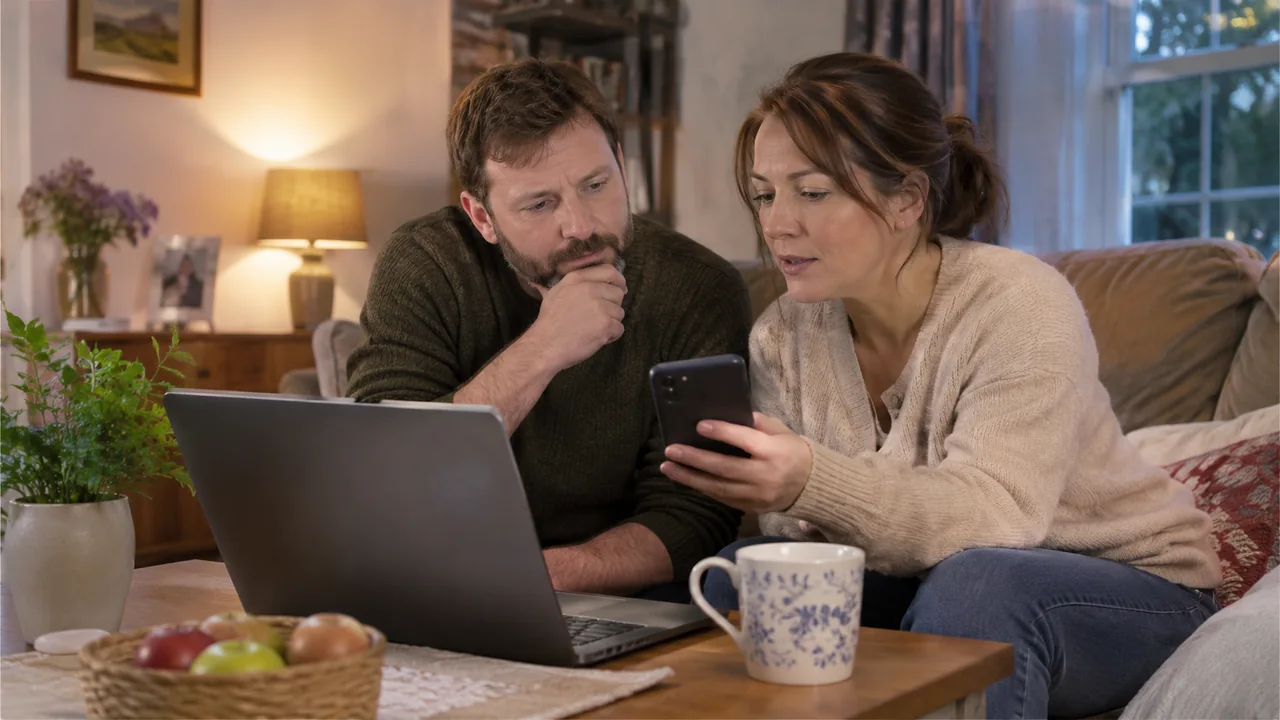
The video looks like breaking news. A familiar voice says that objects have appeared above several cities, and a caption urges everyone to leave immediately. Before anyone establishes whether the report is genuine, families are calling relatives, sharing the clip and deciding whether to get in the car.
Fake alien invasion reports could create real-world harm even if there were no alien event at all. The mechanism is human: a convincing false claim influences decisions about movement, money, trust and personal safety. It does not require everyone to believe the story or an entire country to panic.
This article examines that possibility, not a confirmed invasion or a prediction of mass hysteria. The useful question is how to prevent an extraordinary claim from producing ordinary injuries, fraud and disruption before its evidence has been checked.
A false report does not need to look ridiculous
An obviously fictional spaceship is easy to dismiss. A believable false report may be much less dramatic: an edited announcement, a real recording from another year or an authentic image attached to a false location. Deception often works by changing context rather than creating every detail from scratch.
AI-generated material adds possibilities, but the problem is wider than AI. A genuine person can repeat an untrue claim sincerely. An account with a long history can share something it has not verified. A familiar face or fluent sentence is therefore not enough to establish authenticity.
Ofcom's discussion of deepfake attribution explains why labels, provenance and related measures have strengths and limitations. No single visual clue should carry the entire burden of deciding whether a report is true.
The dangerous step is often the action attached to the claim
A strange story becomes more consequential when it tells people to do something immediately. Leave a city, pay for a place in a shelter, withdraw money or share a warning with everyone you know: each instruction can produce effects before the underlying event is established.
The urgency may be the mechanism of deception. A person who believes there is no time to check is easier to push towards an unnecessary decision. The message may also imply that anyone who pauses is endangering their family.
Separate the claim from the demand. What is supposedly happening, and what are you being asked to do because of it? Each needs justification. A frightening video does not automatically validate the payment link, travel instruction or accusation attached underneath it.
Why familiar voices and official-looking graphics can mislead
People reasonably rely on recognisable institutions in a crisis. A false report can borrow that trust through a copied logo, a similar account name or audio that appears to come from a known speaker. The appearance of authority then substitutes for confirmation of the source.
The FBI's public warning about AI-assisted fraud describes misuse of synthetic text, images, audio and video. Its relevance is the method of impersonation, not evidence that alien-invasion scams are currently widespread.
Treat a forwarded recording as a claim to investigate. Find the organisation's actual website or established channel independently. Do not use contact details supplied only by the suspicious message. A copied badge on a screen is not the same thing as a statement published by the organisation it resembles.
Viral repetition is not independent confirmation
Ten accounts may all be sharing the same original clip. A news-style page may cite another page that ultimately links back to the same anonymous upload. The number of copies can create an impression of corroboration without adding any new evidence.
Independent confirmation means that separate observations or responsible investigations support the claim. It is not simply a collection of people agreeing that the first video looks convincing. Ask whether the reports have different evidence or merely different captions.
This is particularly important when a story claims multiple incidents. One recording can be relabelled as several locations. Before concluding that a threat is widespread, establish whether each location has its own verified evidence. A map covered in markers is not a substitute for that work.
Unidentified does not mean extraterrestrial
An observation may remain unexplained because the available data are incomplete. It may be difficult to judge distance, scale or motion from a short clip. Those limits do not identify an alien craft.
NASA's UAP information helps keep that distinction visible. A claim of extraterrestrial origin needs evidence beyond the absence of an immediate explanation. A claim of invasion needs still more evidence about arrival, behaviour and intent.
These are separate steps. A report that jumps from a light in the sky to a nationwide attack has not necessarily answered any of them. Asking for the missing evidence is a reasonable response, even when the person sharing the clip is a trusted friend.
How a rumour could disrupt roads and essential services
Consider a hypothetical false evacuation message affecting a busy urban area. Some people might leave work early, collect children or drive towards a limited number of routes. Others might travel towards the supposed event to watch it. The resulting movement could create risks unrelated to any alien claim.
That does not mean a viral rumour will inevitably produce mass panic. People respond differently, and many will check or ignore the report. The point is that even a smaller number of unnecessary journeys can matter in an already congested or disrupted place.
Emergency services could also receive calls asking whether the story is true. A non-urgent attempt to verify a rumour should not occupy a route intended for immediate danger. Use official information channels for checking, while keeping emergency assistance available for people facing actual emergencies.
A family can be targeted without a public scare
A scam does not need a national audience. Someone might contact a household claiming that a relative has been caught in an incident and needs immediate money. The alien story supplies urgency; the real aim is access to funds or personal information.
A convincing voice is not enough to authenticate the request. Contact the person through a number or method you already trust. If that is not immediately possible, ask another trusted contact to help verify the situation rather than following the stranger's payment instructions.
Do not treat a demand for secrecy as a sign of legitimacy. A message saying that authorities are hiding everything and only the caller can arrange safety removes the very checks that could expose the deception. The stronger the pressure to bypass verification, the more carefully the request deserves examination.
Check an alleged emergency alert through the real service
For UK readers, GOV.UK explains Emergency Alerts and provides information for checking genuine alerts. The service does not ask people to provide personal details and does not send its alerts by email. An email using its name should not be accepted as an official alert.
A forwarded screenshot is different from an alert received through the service. Check the original wording, date and affected location. Do not assume that a message relevant to another area or a past exercise applies to your household now.
For an actual alert, follow its applicable instructions. If you are driving, do not handle the phone to investigate it; stop somewhere safe and legal before reading. A rumour should never persuade you to create an immediate road danger while trying to determine whether a distant danger exists.

A practical verification sequence
Begin with the original source rather than the most dramatic version. Find the named organisation independently, then look for a dated statement matching the claim. Compare what it actually says with the forwarded caption.
Next, identify whether the content is a live report, historical recording, simulation, satire or unresolved observation. A real exercise can include severe fictional consequences without being a warning that those consequences are happening. The missing label can change the meaning completely.
| Check | Useful question | Reason to pause |
|---|---|---|
| Origin | Where did this first appear? | Only anonymous copies can be found |
| Time | When was it recorded or published? | An old clip is presented as live |
| Place | What independently confirms the location? | The caption is the only location evidence |
| Authority | Is the statement on the real organisation's channel? | A screenshot is the only supposed proof |
| Demand | Why must I pay, travel or share immediately? | Verification is discouraged or punished |
Why an AI detector cannot settle every argument
A detector's output is not a substitute for an investigation into origin and context. A genuine image can be used deceptively, while a synthetic illustration can be clearly labelled and entirely legitimate. The question is not only how material was made, but what it is being used to claim.
Image quality is also an unreliable shortcut. A polished clip may still be false, and a poor recording may show a genuine ordinary event. Looking for odd fingers or unnatural lighting can be one clue, but it should not become a guaranteed test.
The stronger approach combines source checking, independent evidence and attention to the attached instruction. If those are missing, the material remains unverified even when it looks convincing. If they are present, they deserve more weight than a stranger's confident comment about how real the pixels appear.
Correct the claim without humiliating the person
A relative may share a warning because they care. Mocking them can make the correction harder to accept and discourage future questions. Explain what you checked and offer the original source where possible.
A useful response might say that the clip is from an earlier event, the named organisation has not issued the quoted instruction or the image is labelled as an illustration at its source. Keep the correction tied to evidence rather than a judgement about the person's intelligence.
If you shared the claim yourself, correct it in the same place. Do not assume that quietly deleting your post informs everyone who saw it. A clear update can stop the chain more effectively than a private admission that never reaches the original audience.

Children need an explanation, not an endless replay
A frightening clip can feel immediate to a child, especially when adults repeatedly discuss it. Ask what they have seen and what they think it means. Then explain the difference between a story, an illustration and a verified event in language they understand.
Do not promise that no emergency can ever happen. Explain that a video needs checking and that adults can use reliable information to decide what matters locally. The goal is to restore a sense of how decisions are made, rather than replace one unsupported certainty with another.
If the claim is unverified, stop treating it as background entertainment in the home. Repeated exposure can keep the fear active even after the adults consider the matter settled. A calm conversation and a return to ordinary activity may be more useful than another hour of speculative commentary.
Refuse accusations against real people
A false invasion story may name a group as collaborators or claim that neighbours are hiding something. Those accusations can cause direct harm. A dramatic narrative is not evidence of a person's secret identity, allegiance or involvement.
Do not investigate strangers, trespass on property or share personal details because an account encourages it. If there is a real immediate threat, use the appropriate emergency route. Otherwise, keep the focus on checking the claim and reporting harmful content through relevant channels.
The responsibility is especially important when a story borrows national or religious stereotypes. Protecting a family does not require turning another family into a target. An extraordinary allegation should increase the demand for verifiable evidence, not lower it.

Keep a false report separate from a real local problem
A rumour can circulate at the same time as an ordinary emergency. A power cut, fire or transport incident still deserves attention on its own terms. Do not ignore practical local information because the online discussion is dominated by an extraordinary explanation.
Our article on a hypothetical advanced civilisation separates unknown capabilities from invented certainty. The discussion of biological first-contact concerns makes the same distinction for claims about illness and exposure.
These boundaries help readers avoid two mistakes: accepting every frightening explanation, and dismissing all actual problems because one explanation was false. A corrected rumour does not mean a damaged road is safe. It means the road should be assessed through the evidence relevant to the road.
Your next step
Agree with your household that an alarming forwarded message will be checked before anyone sends money, begins an unnecessary journey or shares a claimed instruction. Choose a trusted way to contact one another independently if a caller claims that a relative is in danger.
Then practise tracing one extraordinary story to its original source. Note whether the source supports the caption and whether the date and location match. This is a practical skill that applies well beyond alien claims.
The threat is not that every viewer will panic. It is that a believable false report can influence enough decisions to injure people, interrupt services or enable fraud. Refusing to let urgency cancel verification is a small action with real value for the people around you.
Frequently asked questions
Could a fake alien-invasion story cause harm without a real invasion?
Yes. False instructions could influence travel, payments or the use of services. The scale would depend on the circumstances and people's responses. Harm is possible without assuming that everyone believes the story or that mass panic is inevitable.
Does an unexplained object prove an alien invasion?
No. An unidentified observation, an extraterrestrial origin and hostile action are separate claims. Each needs evidence. Missing information about a video does not establish the most extraordinary explanation.
Can I rely on how realistic a video or voice sounds?
No. Convincing material can be altered, synthetic or used in the wrong context. Check its origin, date, location and independent confirmation. A familiar appearance or voice does not authenticate a payment request or emergency instruction.
Where can UK readers check a claimed Emergency Alert?
Use the official GOV.UK Emergency Alerts information and genuine-alert checking facilities. Find the site independently rather than relying on a forwarded screenshot or suspicious link. The service does not request personal details or send alerts by email.
What should I do if I have already shared an unverified warning?
Check it promptly and post a clear correction where you shared it if the claim is false or unsupported. Explain the evidence without shaming others. Quiet deletion alone may not reach the people who saw and passed on the original message.